At Stanvalves, our engineering focus is not only on designing robust valves but also on helping system designers understand how operating conditions influence component life. One of the most overlooked factors is the turbulence and jetting behaviour created when a ball valve is not fully open. This phenomenon becomes even more critical when the fluid contains abrasive particles, which can accelerate wear exponentially.
This article provides a technical overview of these effects and explains why understanding flow characteristics is essential for equipment longevity and system reliability.
Ball valves are primarily designed for on/off isolation. When fully open, the bore of the ball aligns with the pipeline, offering minimal flow disturbance. In contrast, partially closing the valve introduces a sharp, irregular orifice, which changes the flow regime in several ways:
As the valve closes, the flow stream constricts into a high-velocity jet. This causes the formation of a vena contracta—the narrowest point of the stream, where velocity peaks and pressure drops. The resulting jet exits the valve at significant velocity, striking downstream pipe walls at a concentrated point.
The uneven opening and sharp edges around the partially rotated ball create chaotic flow:
These turbulent structures greatly influence erosion and mechanical stress.
The combination of high-velocity jetting and turbulence leads to localized mechanical wear that can affect:
The jet from a semi-closed ball valve often hits the downstream pipe wall at a consistent location. Over time, this leads to:
Carbon steel pipes are particularly susceptible; even stainless steel can wear prematurely depending on fluid velocity and chemistry.
The turbulent flow field induces pressure fluctuations that can propagate along the pipe, causing:
This effect is often mistakenly attributed to mechanical misalignment rather than flow disturbance.
When solids are entrained in the fluid—such as sand, scale, catalyst fines, or mineral particles—the wear mechanism becomes erosive rather than simply mechanical.
Abrasive particles gain kinetic energy as they pass through the restricted orifice. The high-velocity jet then:
This accelerates wear dramatically—sometimes reducing component life from years to months.
In highly turbulent regions, particles remain suspended longer and impact surfaces repeatedly. This persistence increases:
Roughened surfaces then create even more turbulence, forming a feedback loop that accelerates degradation.
Abrasive particle jets can damage:
Unexpected failure in these components can result in costly downtime and safety risks.
Although a ball valve can be used in a throttled position, it is not engineered for:
For throttling applications, Stanvalves typically recommends:
These alternatives provide better flow stability, reduced jetting, and lower erosion potential.
If process constraints require ball valves to operate partially open, key engineering mitigations include:
Stanvalves engineers routinely work with clients to model these scenarios and recommend suitable designs.
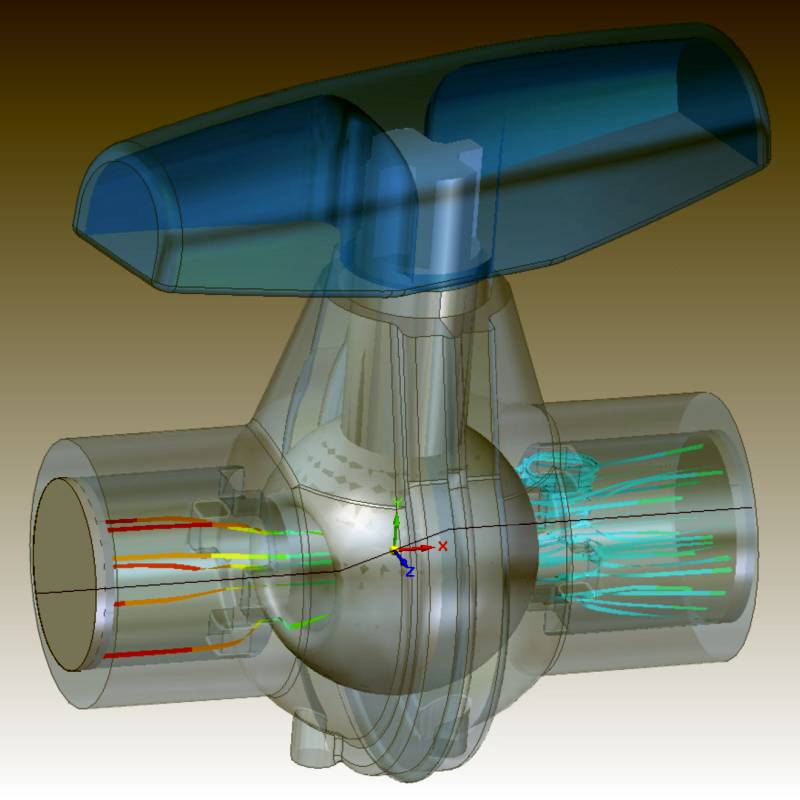
Stanvalves uses Computational Fluid Dynamics (CFD) software to simulate:
Understanding these characteristics at the design stage enables:
Stanvalves incorporates these analytical methods into our valve development and customer support workflow to ensure optimised performance under real-world conditions.
Operating a ball valve in a semi-closed position significantly alters its flow characteristics, increasing turbulence, jetting, and downstream erosion. When abrasive particles are present, these effects are magnified, posing considerable risks to pipes and equipment. Understanding these phenomena is essential for ensuring system reliability, safety, and long-term operational efficiency.
At Stanvalves, we design our valves to meet rigorous performance demands—and we support engineers with the data, analysis, and technical insight required to make informed decisions. Optimising flow conditions is not only good engineering practice; it is essential for protecting downstream assets and ensuring a cost-effective, dependable process system.